Checkers is a classic game of many generations and is still a favorite game worldwide. The gameplay is easy but requires your quick thinking ability.
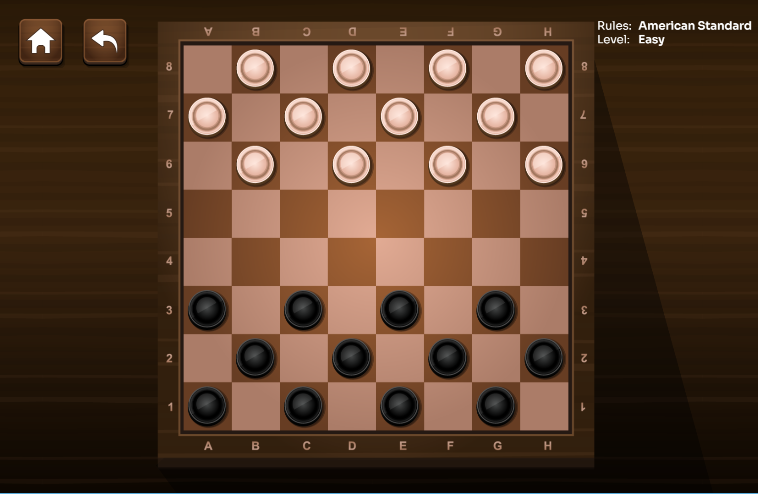
The game is played on an 8×8 board consisting of 64 squares; only the 32 dark-colored squares (brown tiles) are playable, while the 32 light-colored squares are purely decorative. Each player begins with 12 pieces, arranged across the three rows closest to their side.
- Players may capture an opponent's piece by jumping diagonally over it into an empty square beyond.
- A single piece may perform multiple consecutive jumps in one turn, provided that each landing square offers an opportunity for another capture.
- A player wins by capturing all of the opponent's pieces or by leaving the opponent with no legal moves.
The game ends in a draw if the same board position occurs three times (threefold repetition), or if 40 consecutive moves are made by each side without any captures or standard piece movements.
Since pieces on the sides cannot leap, novice players occasionally rely on them for protection. However, it's preferable to move your pieces in that direction. Although it may appear that you are more open to assaults from this position, taking the middle will eventually provide you with more mobility.
The "home row" refers to the back row of checkers on either side. It's preferable to save the pieces for this row until you really need them. By keeping your home row full, you may jump and capture any enemy pieces that approach too near while also preventing your opponent from constructing Kings.
You should concentrate only on moving as many pieces to the other side of the board as you can at the beginning of the game in order to assemble a team of Kings. It's ideal to have a head start in Checkers since the player who has the most kinged pieces on the board will likely win the game.
When you take all of your opponent's pieces or when they are unable to move anymore, your opponent loses. Look for opportunities to build a wall around your opponent's checkers as you move your pieces across the board, but it could be a little tough at first. You will win if you successfully block the adversary.
If you're ahead in the game, it could be advantageous to give up or exchange some of your pieces if doing so results in gaining more adversarial pieces and moving the game forward across the board.
Play Checkers now to put your calculation skills to the test with your game pieces!